


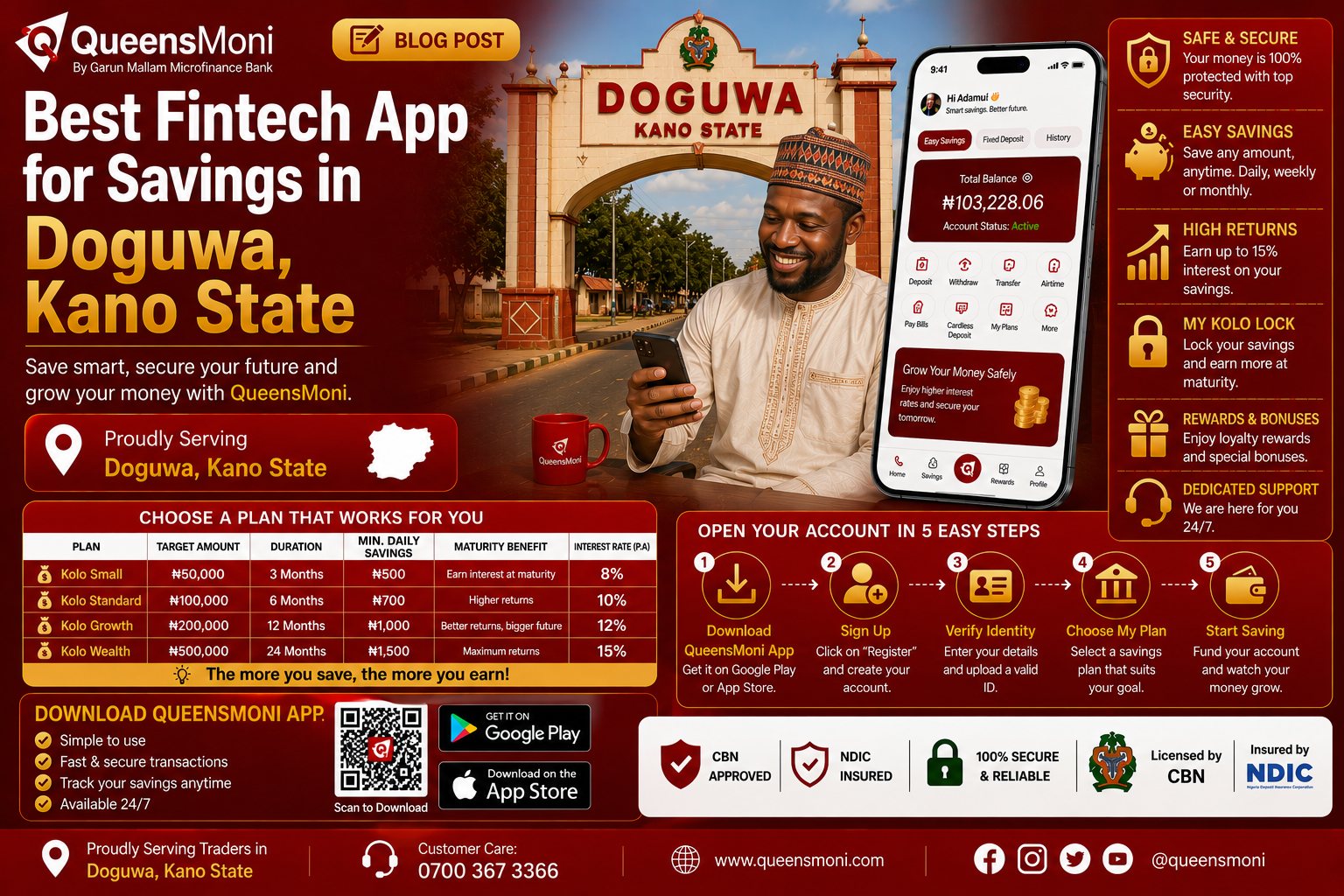
Doguwa is one of Kano State’s larger, more rural local government areas, with farming forming the backbone of most household income. If you’ve searched for the best fintech app for savings in Doguwa, Kano State, you’ve probably already noticed that most of the popular options weren’t really built with a place like Doguwa in mind. This is meant to change that: a proper, honest look at what actually matters when choosing where to save here and where Queensmoni fits into that picture.
Why one generic answer never really works
A lot of financial content tries to answer “what’s the best savings app” with a single, confident recommendation, as though everyone reading has the same income pattern. That’s rarely true anywhere, and it’s especially untrue in Doguwa. There are farmers whose income arrives in a harvest lump sum followed by months of comparatively little. There are traders bringing in daily income that shifts unpredictably. There are civil servants and teachers with a fixed monthly salary landing on schedule. And there are younger residents just starting to build any kind of savings habit at all.
Each of these groups genuinely needs something different. A farmer needs somewhere to park a harvest lump sum so it grows instead of quietly shrinking over the following months. A trader needs a plan that accepts small, frequent, unpredictable deposits without demanding a fixed monthly figure they can’t reliably hit. A civil servant benefits most from full automation that removes the need to think about saving at all. And someone just starting needs low barriers to entry and enough incentive to keep going even with small amounts.
What genuinely separates a good savings app from a good advert?
Before naming specific platforms, it’s worth being clear about what actually matters, because a lot of savings apps look similar on the surface but behave very differently once you dig in.
Does it actually pay interest, and is the rate clearly stated rather than buried in vague language? An app that doesn’t meaningfully grow your money is really just a digital version of keeping cash at home, minus the risk of theft, which is something, but leaves real value on the table.
Does the product actually match how your income arrives? This is the point most comparisons skip over entirely, and it matters enormously. A plan built around one fixed monthly deposit will frustrate a farmer or trader whose income shifts through the year, while a fully flexible plan with no structure at all might not build enough discipline for someone who genuinely needs a bit of friction to actually save.
What happens if you need to withdraw early? Some apps make this completely frictionless, which sounds convenient but often works against you, since easy access is frequently exactly why savings plans quietly fail before producing anything meaningful.
Are there hidden fees chipping away at a balance that took real effort to build? This matters more than people expect, especially for smaller, hard-earned amounts.
And does the platform actually understand where you live, or does it assume you’re a salaried professional in a big city with a completely different financial life than yours?
The names you’ve probably already heard of
If you’ve looked into savings apps in Nigeria before, PiggyVest and Cowrywise are names you’ve likely encountered. Both are genuinely well-built, widely trusted, and used by millions of people nationwide. PiggyVest built its reputation on making automated saving simple, with products like Safe Lock and Flex Naira becoming fairly recognisable names in Nigerian personal finance. Cowrywise leans more toward mutual funds and structured investment plans, appealing especially to salaried professionals who want their savings doing something more sophisticated than just sitting untouched.
Both are solid choices on their own terms. The issue for Doguwa specifically is that neither was designed with this kind of economy in mind. They’re national products built around a fairly generic, often urban and salaried, user profile. If your income comes from farming, you may find their tools technically function but don’t really flex to match your actual reality.
Where Queensmoni tries to do something different
This is the gap Queensmoni is built around. Rather than assuming everyone earns the same way, it offers a small set of structured products designed to match different income patterns, with a stronger focus on Kano State communities specifically rather than a purely national, one-size-fits-all approach.
There are two core structured savings products, and both run on auto-debit, meaning your money moves automatically on a schedule you decide, rather than depending on manual transfers every single time.
My Kolo is the flexible option, designed for smaller, frequent deposits rather than one large fixed monthly sum, which fits an income that arrives in bursts far better than a traditional savings account would. It currently earns around 15% interest per year, and there’s an important detail worth understanding upfront: if you withdraw before the date you originally committed to, you lose 25% of the interest that had built up. That’s not an accident; it’s meant to make casual, impulsive withdrawals genuinely uncomfortable, so the savings habit actually sticks.
Queens Lock goes further still. It’s for money you want properly out of reach until a specific goal is reached, whether that’s a wedding, school fees due at a known date, or a business investment you’re planning for months. It’s essentially putting your own money somewhere slightly inconvenient to access, because for a lot of people, that inconvenience is exactly what makes saving actually work.
Beyond those two, there’s Fixed Deposit for larger lump sums, useful for a farmer who’s just come off a strong harvest and wants that money to grow properly rather than slowly disappearing over the following months. Rates on Fixed Deposit improve both with the size of the deposit and the length of time you’re willing to commit it for, running from 90 days up to a full year.
And for residents thinking further ahead than just saving, a broader investment solution is offered, with structured plans and portfolio guidance for those wanting to build wealth over a longer horizon.
Matching the right product to your actual situation
If you’re a farmer in Doguwa, the most useful approach is often to use My Kolo and a Fixed Deposit depending on timing. Smaller ongoing contributions during the growing season can go into My Kolo, and a larger post-harvest lump sum is a natural fit for Fixed Deposit, where it can grow properly instead of slowly being spent down over the following months.
If you’re trading, My Kolo is really the obvious starting point. It’s built around exactly your kind of income pattern: small, frequent, unpredictable amounts that don’t fit neatly into a monthly savings target.
If you’re a civil servant or salaried worker, either My Kolo or Queens Lock can work well as an automated habit, with Queens Lock being the stronger choice if you know you’re the type to dip into savings given the option.
And if you’re just starting out, whether as a student or someone early in their working life, starting small with My Kolo and building the habit before moving toward more structured products like Fixed Deposit tends to work better than trying to commit to something ambitious right away.
Actually getting started
Getting set up doesn’t require visiting an office or filling out physical paperwork. You’ve got a few options depending on what’s convenient for you. You can visit queensmoni.com directly from a browser on your phone or computer. If you’re on Android, you can download the app on Google Play. And if you’re on iPhone, it’s available through the Apple App Store as well.
Wherever you sign up, you’ll need a valid means of identification, whether that’s a National ID, voter’s card, driver’s license, or international passport, along with your Bank Verification Number, or BVN. This is standard practice across any regulated financial platform in Nigeria and isn’t unique to Queensmoni.
Once you’re registered, choose the product that actually fits your situation rather than picking whatever sounds most appealing. Decide on a deposit amount you can genuinely sustain, not your best-case scenario but your realistic average. And then, honestly, the most important step is just starting. A small first deposit that you’re consistent with will always beat an ambitious plan you abandon after a few weeks.
Things worth knowing before you commit
Don’t choose a platform purely because everyone else is using it. Popularity doesn’t automatically mean fit, and what works well for a salaried professional in Lagos might not suit a farmer in Doguwa at all.
Read the actual terms around early withdrawal before locking money into something like Queens Lock. It’s a genuinely useful tool, but only if you’re realistic about your own discipline going in.
Set your savings target based on a true average of your income, not your best week or your best harvest. Overcommitting early is one of the most common reasons people quietly give up on a savings plan within the first couple of months.
And whichever platform you eventually choose, take a moment to check its regulatory backing. Queensmoni, for what it’s worth, is backed by a licensed microfinance bank, which covers the regulatory side of things. Still, it’s good practice to verify current licensing details directly before committing any significant amount of money, regardless of which provider you’re considering.
Questions people in Doguwa tend to ask
Is there really a difference between a national savings app and something like Queensmoni?
The core mechanics aren’t wildly different, but the product design and flexibility around irregular income tend to differ. Apps like PiggyVest and Cowrywise are built around a fairly generic, often salaried user, while Queensmoni’s My Kolo product specifically accommodates smaller, frequent, unpredictable deposits, which fits farming income patterns more naturally.
I’m a farmer and my income really only comes in after harvest. What should I actually do?
A Fixed Deposit is usually the better fit for that lump sum, since it locks the money in and grows it at a proper rate rather than letting it slowly get spent down over the following months. You can also use My Kolo for smaller amounts during the growing season if you have anything spare to set aside.
What actually happens if I break my My Kolo plan early?
You’re able to withdraw the money, but you’ll forfeit 25% of the interest that had accumulated up to that point. It’s designed as a deterrent rather than a strict lock, so it’s still accessible if you genuinely need it, just at a real cost.
Can I use Queensmoni on an iPhone, or is it Android only?
It’s available on both. You’ll find it on the Apple App Store as well as on Google Play.
Is my money actually safe if I use Queensmoni?
It’s backed by a licensed microfinance bank, which handles the regulatory side of things. As with any financial provider, it’s worth confirming current licensing details directly before depositing a significant amount, and that applies whichever platform you end up choosing.
How much do I actually need to start saving?
There’s no meaningful minimum that should stop you from starting. The habit matters more than the amount in the early stages. Start with whatever you can genuinely sustain and build from there.
The honest bottom line
There isn’t a single best fintech app for savings in Doguwa, Kano State, that works equally well for everyone, and anyone telling you otherwise probably isn’t accounting for how different farming income, trading income, and salaried income actually are. PiggyVest and Cowrywise are solid, proven platforms if your income is fairly predictable and monthly. But if you’re farming or dealing with income that doesn’t arrive on a fixed schedule, Queensmoni’s My Kolo and Queens Lock plans, alongside Fixed Deposit for larger lump sums, are built around exactly that kind of reality in a way the bigger national apps generally aren’t.
If you want to see how it actually feels, you can get started at Queensmoni, or download the app directly on Google Play or the Apple App Store.