


Tsanyawa’s economy is built around farming, and if you’ve lived there for any real length of time, you know how a good season can put a genuinely meaningful sum of money in your hands all at once, money that then has to somehow last through the quieter months until the next harvest comes around. If you’ve managed to build up some savings, whether from farming, a small business, or years of steady work, it’s worth asking a serious question: is that money actually growing, or is it just sitting somewhere waiting to slowly get spent?
That’s exactly the gap a fixed deposit investment plan is designed to close, and it’s worth understanding properly before committing any real money to it.
What a Fixed Deposit actually is, in plain terms
An ordinary savings account, even a genuinely good one, is built around flexibility. You can add to it whenever you like, and you can pull money out just as easily. That flexibility is useful for everyday saving, but it comes with a cost: the interest rate on flexible savings tends to stay modest, because the provider can’t count on that money staying put for any particular length of time.
A fixed deposit works differently. You commit a specific lump sum for a set period, and in exchange, you get a noticeably better interest rate than flexible savings would ever offer. You’re giving up some flexibility, and in return you’re getting a better return on the money you can genuinely afford to set aside.
For a resident of Tsanyawa, this tends to make the most sense in a few specific situations. Perhaps you’ve just had a strong harvest and have a lump sum you don’t need to touch for the next several months. Perhaps you’ve built up savings over time through a small business or years of steady contributions and have finally reached an amount worth doing something more deliberate with. Or perhaps you’re planning something with a known date attached, a wedding, a building project, or school fees due at a specific point, and you’d rather that money actually grow in the meantime instead of just sitting still.
How the rates are actually structured
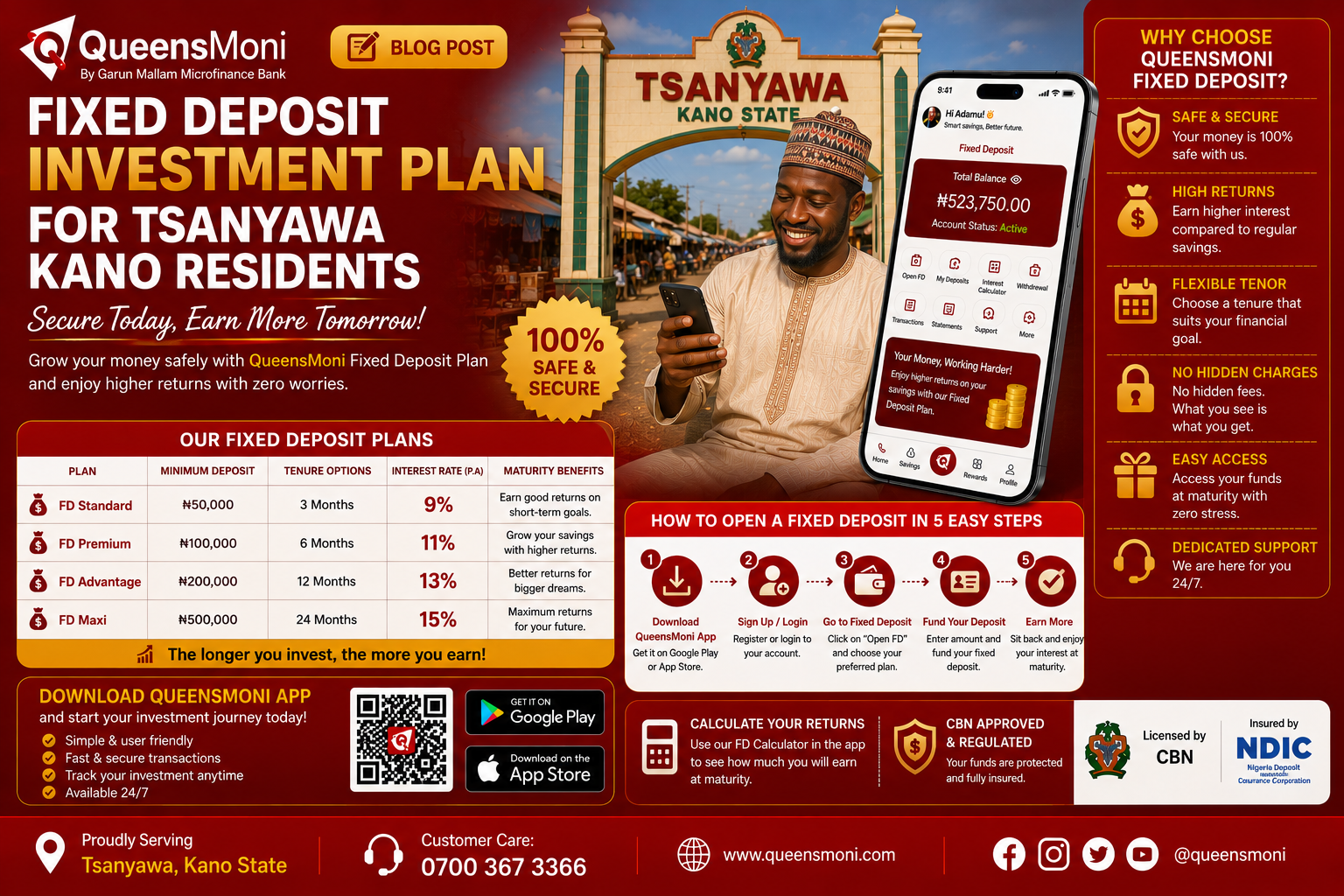
Queensmoni’s Fixed Deposit plan is built around two factors that together determine your return: how much you deposit and how long you’re willing to commit it for.
Tenors run from a short 90-day term up to a full year at 365 days, and as a general rule, committing for longer earns a better rate than a shorter term does. The same logic applies to the deposit amount itself. Larger deposits sit in higher rate tiers than smaller ones, meaning the more you’re able to commit, the better your return becomes, on top of whatever benefit comes from choosing a longer tenor.
There’s also an option for foreign currency deposits in US dollars, following its own separate tenor and rate structure distinct from naira deposits, worth knowing about if you happen to have savings in dollars you’d like to see grow rather than sit idle.
Because these rate tiers are reviewed periodically and can shift over time, it’s genuinely worth checking the current published figures directly through the app or website before committing any money. The underlying pattern, that longer commitments and larger amounts both earn more, tends to hold steady even as the exact numbers get adjusted from time to time.
How this compares to the more familiar national platforms
If you’ve researched savings and investment options before, PiggyVest and Cowrywise are names you’ve probably come across. Both are large, trusted, and used by millions of people across Nigeria. What neither really offers, though, is anything built with a specific understanding of a farming community like Tsanyawa, where income genuinely follows the agricultural calendar rather than a fixed monthly schedule.
Queensmoni takes a different approach. Its Fixed Deposit plan comes with clearly tiered rates that reward both size and commitment, and it’s built to work alongside its other savings products, My Kolo for everyday flexible saving and Queens Lock for more firmly committed goals, so residents can build toward a Fixed Deposit gradually through smaller regular contributions rather than needing a large lump sum ready from the very start.
Getting started with a Fixed Deposit plan
The first real step is being honest about how much you can genuinely commit without needing access to it before the term ends. There’s little point locking away money you’ll actually need in three months for something you hadn’t planned for.
From there, choose a tenor that matches your actual goal rather than automatically picking the longest option purely because it carries the best rate. If you know you’ll need the money back in six months for a specific purpose, a 180-day term makes far more sense than locking it away for a full year and then facing an awkward decision when the need arises early.
Signing up doesn’t require a long trip anywhere. You can visit queensmoni.com directly from a browser on your phone or computer, download the app on Google Play if you’re using an Android device, or get it from the Apple App Store if you’re on an iPhone. You’ll need a valid means of identification and your bank verification number to register, standard requirements across any regulated financial platform operating in Nigeria.
Before actually funding the Fixed Deposit, take a moment to confirm the current rate for your specific deposit size and chosen tenor, since these figures are reviewed periodically, and it’s worth knowing exactly what you’re committing to. Once the deposit is placed, the best approach is simply to leave it alone until maturity, since breaking it early generally means giving up some or all of the benefit you were working toward in the first place.
Who this genuinely suits in Tsanyawa
Farmers who’ve had a strong season and want that lump sum to grow properly rather than slowly getting spent down over the following months are probably the clearest fit here. So are residents with savings built up over years, perhaps from a small business or from consistent contributions to My Kolo, who’ve now reached a point where moving a portion into something higher-yielding makes sense.
Families planning toward a specific future event with a known timeline- a wedding, a building project, school fees due at a particular point- also benefit from the predictability a Fixed Deposit offers. You know roughly what you’re putting in, roughly what you’ll get back, and when to expect it.
And anyone who’s been saving steadily through My Kolo and has built up a balance worth diversifying can use a Fixed Deposit as a natural next step, moving a portion of accumulated flexible savings into something that earns a genuinely better rate.
A few honest considerations before committing
Don’t put every bit of your savings into a Fixed Deposit. Keep something accessible on the side for genuine emergencies, since the entire point of locking money away is defeated if you’re forced to break the term early and lose out on the benefit you were working toward.
Match the tenor to your actual timeline rather than defaulting to whatever earns the highest headline rate. A better rate on a term that doesn’t match your real needs isn’t actually a good deal if you end up needing to withdraw before it matures.
And take a few minutes to confirm the provider’s regulatory standing before placing any significant amount. Queensmoni, for context, is backed by a licensed microfinance bank, but it’s still worth verifying current details directly, and this applies to any financial provider you’re considering, not just this one.
Frequently asked questions
What actually makes a Fixed Deposit different from a regular savings account?
You commit a lump sum for a set period, typically 90 to 365 days with Queensmoni, and in return you earn a meaningfully higher interest rate than flexible savings would offer. The trade-off is reduced access to the money until the term ends.
Does depositing a larger amount really earn a better rate?
Yes. Rates are tiered by deposit size, in addition to increasing with longer tenors. It’s worth confirming the current rate for your specific amount directly through the app or website, since exact figures get reviewed periodically.
Can residents of Tsanyawa open a Fixed Deposit in US dollars?
Yes, Queensmoni offers a separate foreign currency Fixed Deposit option with its own tenor and rate structure, distinct from naira deposits.
Is the Queensmoni app available on iPhone for residents here?
Yes, it’s available on both the Apple App Store and Google Play.
What happens if I need my money before the Fixed Deposit matures?
Fixed Deposit plans are designed to be held until maturity to earn the full agreed rate. It’s important to confirm the specific terms around early withdrawal before committing any funds you might realistically need access to sooner.
Is it possible to build up to a Fixed Deposit gradually rather than starting with a large lump sum?
Yes, that’s actually a common and sensible approach. Saving consistently through My Kolo or Queens Lock first, then moving a portion of the accumulated balance into a Fixed Deposit once it reaches a meaningful size, works well for a lot of residents in farming communities like Tsanyawa.
Final word
For residents of Tsanyawa who’ve built up savings, whether from farming, small business, or years of steady work, a Fixed Deposit offers a straightforward, predictable way to make that money actually work rather than simply sit still. Paired with My Kolo and Queens Lock for everyday saving, it becomes part of a genuinely complete plan, one built around how income actually arrives in a farming community rather than a generic national template that assumes everyone earns the same way.
Ready to look into current rates? Visit Queensmoni, or download the app on Google Play or the Apple App Store.